
Stay with us

AI-Assisted Development: Why We Build Faster?
Companies that adapt will deliver faster.

Today, Claude Code generates over 134,000 GitHub commits daily. Spotify's top developers haven't written a single line of code since December; AI writes most of it. We explain exactly what is changing in software development and how we are responding to it.
The numbers changing development.
In February 2026, one number spread through the tech community. Claude Code - the AI coding agent from Anthropic - generated over 134 thousand GitHub commits daily, accounting for 4% of all public commits worldwide. At the current growth rate of 42,896x over 13 months, it could be every fifth commit by the end of the year. On the other side stands OpenAI's Codex, which surpassed 1.6 million active weekly users. Its usage has grown 5-fold since the beginning of 2026. GitHub Copilot has crossed 20 million. The AI coding tools market exceeded $7.4 billion in 2025.
An interesting report from Spotify: their co-CEO Gustav Söderström stated on an earnings call that Spotify's top developers "haven't written a line of code since December", as AI handles everything via Claude Code and their internal system, Honk. On their way to work, a developer can enter a bug fix or a new feature request from their phone into Slack, Claude implements it, and the finished app version arrives back on their phone before they even reach the office.
Today, AI tools write production code. Every second developer uses them every day. This isn't a buzzword. It's the state of the industry that is changing the rules of software development.
One developer, 10x output.
The question isn't 'Will AI write code instead of us?'. AI writes code, and it's doing it better all the time. But the real impact is different: developers will stop dealing with manually writing routine code and will start focusing on what needs to be built. Instead of a day spent writing boilerplate code, generating tests, or documentation, developers are able to deliver in a day what used to take a week.
GitHub's research shows that developers using AI coding tools complete well-specified tasks significantly faster, by up to 55%. Other metrics show a reduction in the average cycle time for developing new features by tens of percent. The average time saved is around several hours per week per developer. These are feature days returned to the product — and directly to your competitive advantage.
Success in 2026 lies in engineering practice, not in blindly relying on AI, which in independent studies actually slowed down development on complex projects by up to 19%. The key, however, is knowing when to use AI properly and how to effectively integrate it into the system's architectural design.
A paradigm, not a tool.
Companies that view AI merely as advanced autocomplete are overlooking the key question of integration to accelerate development without increasing chaos. The traditional software development model is: a developer gets a ticket with a problem description, writes code, and sends it to the team for review - the team grows linearly with the volume of work - the more work, the more people.
The AI-first model, on the other hand, changes the developer's role from a simple creator to an architect and manager of their own team of AI engineers. The AI-first software development model looks like this: an AI Agent maps the problem and proposes a solution, the developer approves it, the AI implements it, and then reviews it. This approach allows a three-person team to deliver results that previously required ten people. The developer stops being a bottleneck and begins effectively handling multiple tasks at once by fully delegating the executive, time-consuming parts of the work to AI agents.
For complex tasks requiring deep domain knowledge or specific direction, the acceleration in the implementation phase may not be as striking, but AI still significantly saves time in other phases – from task orchestration to automated review and documentation. The key to success is therefore knowing when to let AI lead and when the developer must take the reins.
Why just adding AI isn't enough? ..."vibe-coding"
Here comes a fact that few will admit. Experienced developers ship 2.5× more AI-generated code to production than less experienced ones. This is because AI primarily amplifies abilities - it doesn't replace them.
A current trend is so-called vibe-coding, where a developer doesn't write code but simply describes their vision in natural language. It's a phenomenal tool for lightning-fast prototyping and PoCs, which we also use, but it lacks architectural and security control for production code. Without clear structure, AI coding leads to poor-quality code, which is fast to write but usually more expensive to fix than high-quality, slower-written code, something we've also witnessed. Therefore, our process dictates: the more complex the task, the stronger the role of the experienced developer. They define the context, approve the procedure, and review the solution with a depth matching the task's risk.
Speed without control is simply a path to technical debt that will surface sooner or later.
What it looks like in practice for us.
For us, AI isn't just a smart editor, but a full-fledged system. Every new feature starts with an exploratory phase, where an agent maps out technical possibilities, risks, and edge cases. Together, we then build a plan that the AI subsequently implements under our supervision. This frees our hands for creative architecture, while agents handle routine code, propose testing scenarios, and perform multi-level code reviews from various perspectives. The entire process ends with a final review among developers to guarantee 100% compliance with our standards.
Our agents are fully integrated digital software colleagues. They have an overview of projects, manage git workflows, monitor application logs, deploy systems, write documentation, and autonomously update task management. Thanks to these capabilities and the ability to instruct agents via text – even from a mobile phone – geographical and time barriers disappear, and development becomes faster and cheaper, yet still high quality. Development thus doesn't just happen at a desk, but wherever our people are.
Agents maintain the continuity of work, while we steer the direction.
The future belongs to the prepared: Adaptation as a competitive advantage
AI is not a threat to your business, but to the outdated ways of working we are used to. If you are building a product, don't optimize for the number of developers, but for the quality of the process that AI drives. The real difference isn't in the tools, but in how you organize work around them. A team with a properly set up AI workflow delivers faster, at a lower cost, and without unnecessary technical debt compared to those who just 'tacked on' AI to old procedures.
This transformation isn't just about programming, but about anyone who works with information and decision-making. Developers and companies that rebuild their processes and adapt to this new paradigm will gain a head start that will be hard to catch up with later. Tools are changing at a dizzying pace, and the key question for you isn't 'if', but how your company can change with them.
If you haven't started yet, that's fine – the right time is right now. You don't need a finished plan or a team of AI experts, that's what we're here for. Whether you are just mapping the possibilities, or you feel your team isn't using its full potential, we would love to talk to you about it. No strings attached. Just contact us.
"It's not about how fast you run, but whether you're running in the right direction..."
References
Read next
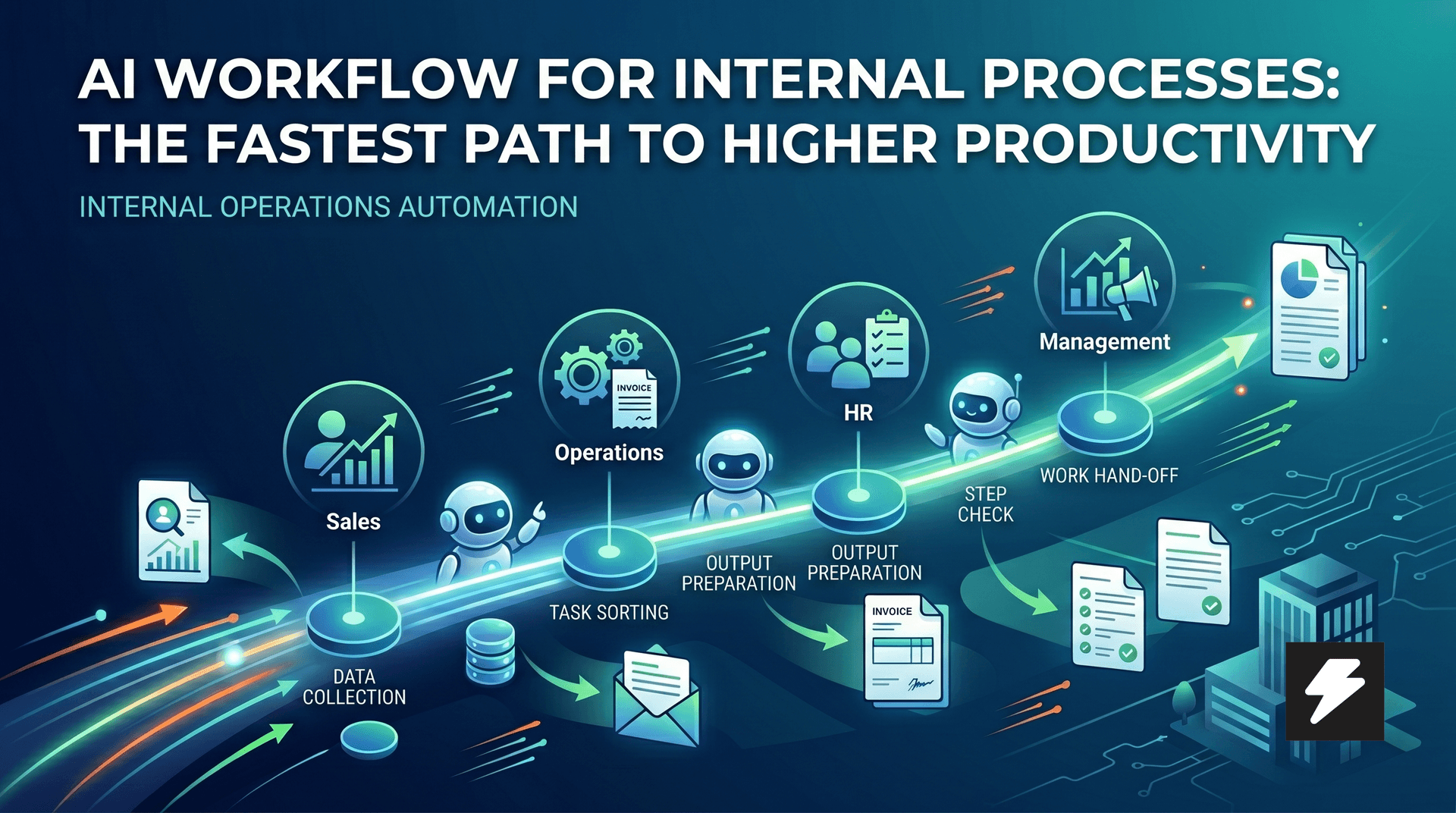
AI Workflows for Internal Processes: The Fastest Path to Higher Productivity
Most companies today approach AI from the visible surface-a chatbot, a copilot in the inbox, or a single smart feature on the website. However, the fastest business impact often lies elsewhere: in internal processes that cost dozens of hours of manual labor every week. This is exactly where it makes sense to build small internal systems and workflows on top of your data. Systems that gather background information, sort requests, prepare outputs, monitor dependencies, and speed up tedious operations. The result isn't just saved time. It's a faster company, cleaner operations, and a team that can focus on more important work.
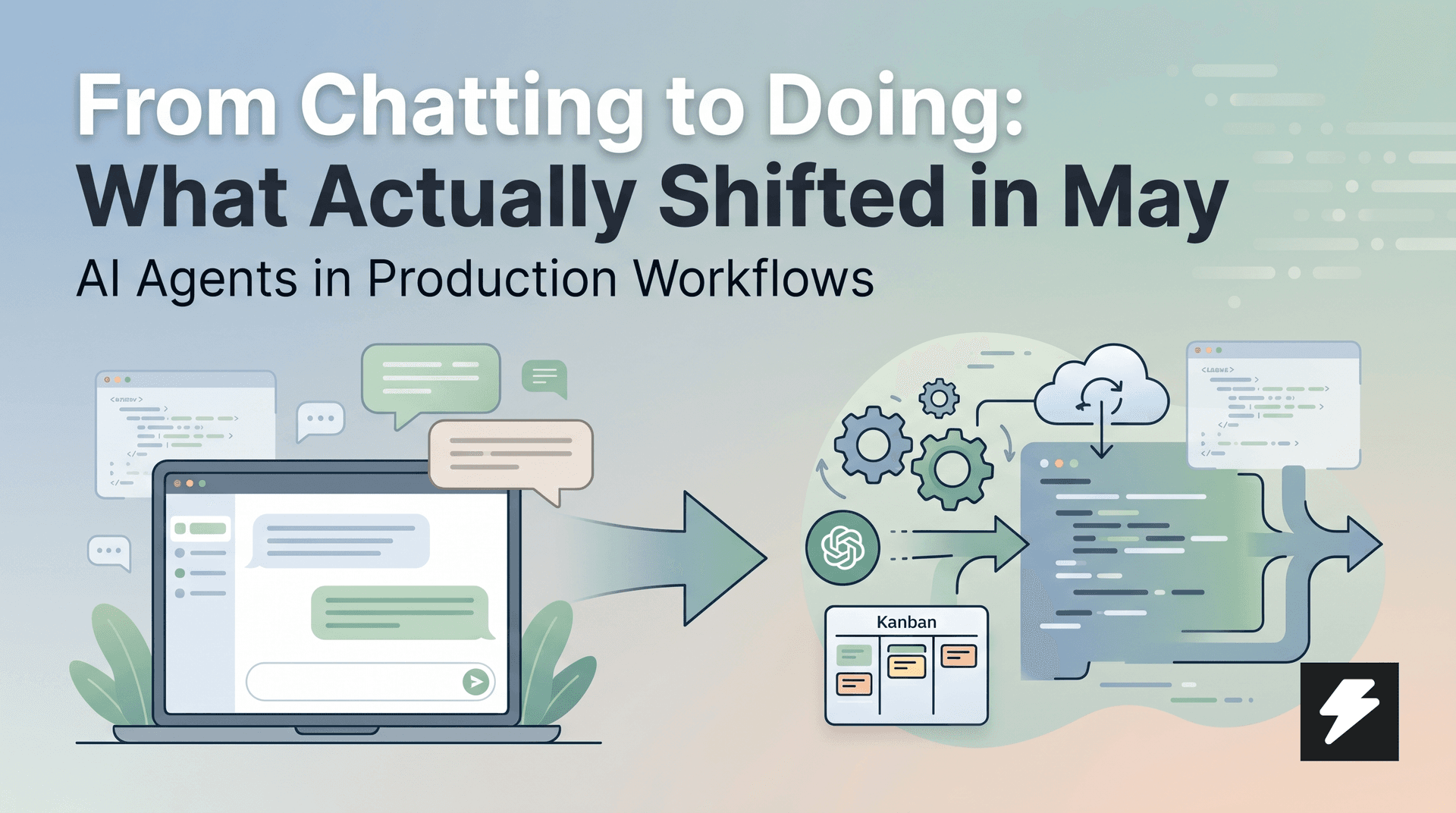
From Chatting to Doing: What Actually Shifted in May
Codex, Claude, Gemini, and Cursor delivered a consistent message in May: agents are moving from chat to production. The focus isn't on a better model, but on environment, governance, and integration with work systems. For companies, this isn't a signal to buy another chat window—it's a signal to rebuild their operating model for AI.
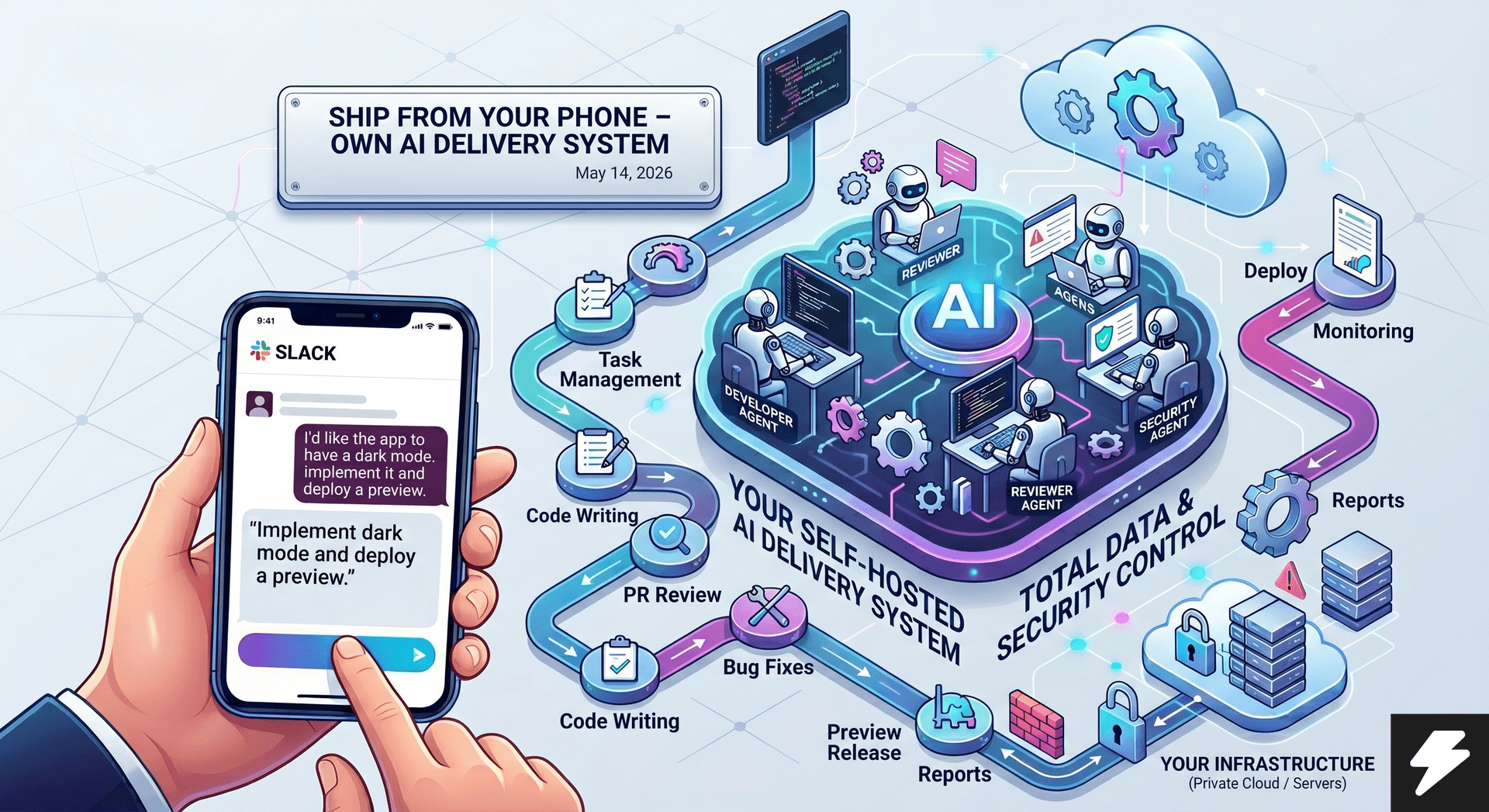
Ship From Your Phone: Your Own AI Delivery System
A single message from your phone triggers the entire delivery engine: PR reviews, incident response, fixes, and preview releases. Within minutes, you get an analysis, a proposed patch, test results, and an audit trail. Everything runs self-hosted, meaning the server, rules, integrations, and data stay fully under your control.